Skip to content
Climbing in the Cordillera Blanca

Peru Climbing Expeditions & Mountaineering Courses

Climb the glaciated peaks of the Cordillera Blanca with our local UIAGM mountain guides — from your first course on the ice to a technical 6,000m summit, planned around your level and led by the family who runs the agency.

UIAGM / IFMGA guides Courses for every level 5,000m to 6,768m peaks
Peru Climbing Expeditions & Mountaineering Courses
Support & safety

Enough staff to bring you down safely

We organise every climbing group so that, in the event of an accident, illness or exhaustion, there are always enough qualified climbing staff on the mountain to carry out a rescue or evacuate clients safely down — sending an assistant guide or porter with you while the rest of the group can continue if they wish. Guides have first aid training and carry a kit, and there is 24-hour radio or phone contact with our Huaraz office. Remember: there is no helicopter rescue service in the Cordillera Blanca, so all rescues are carried out on the ground.
3:1 Maximum

Clients per guide on 5,000m and non-technical peaks

2:1 Max

Clients per guide on 6,000m and technical peaks

UIAGM only

Required for Artesonraju, Alpamayo and Huascarán

UIAGM mountain guides, on the rope with you
The Morales family

UIAGM mountain guides, on the rope with you

Peruvian Andes Adventures is owned and run on the mountain by brothers Hisao and Eli Morales, native climbers from Huaraz.

They belong to a Huaraz family that has guided the Cordillera Blanca since foreign climbers first arrived in the 1960s, and they pair that mountain knowledge with European-audited UIAGM certification. Because they run the agency and lead on the rope themselves, there is no intermediary between you and the people responsible for your safety.

HISAO & ELI MORALES

Founders, Directors & UIAGM Mountain Guides

[ 01 ]

Acclimatisation comes first

Good acclimatisation matters before you attempt any climb in the Cordillera Blanca. You are sleeping and climbing above 5,000m, which is demanding and tiring for the body, and without enough time to adjust you risk altitude sickness or a complete loss of energy that ends the climb early.

We always recommend an acclimatisation trek of at least 4 days before you set off to climb, and we are happy to plan a programme around you with day hikes built in. For 6,000m or technical peaks like Alpamayo, we add a "warm-up" climb of a 5,000m peak to build strength and adjust further before the main objective.

[ 02 ]

Glacier conditions & when to go

Glaciers in the Andes are retreating fast — some peaks climbed thirty years ago have disappeared entirely. Conditions on the ice change every year, and even every month, so route descriptions are general only and many printed guidebooks are already out of date on crevasse hazards and approaches.

Our UIAGM guides read the mountain in the field, and we build our programmes with room to adapt: we will change a section or a high-camp plan when conditions ask for it, because safety always comes before keeping to a fixed line on paper. The best weather is usually May to September, though high-mountain weather is volatile and can turn at any time.

[ 03 ]

Base camp, food & carrying

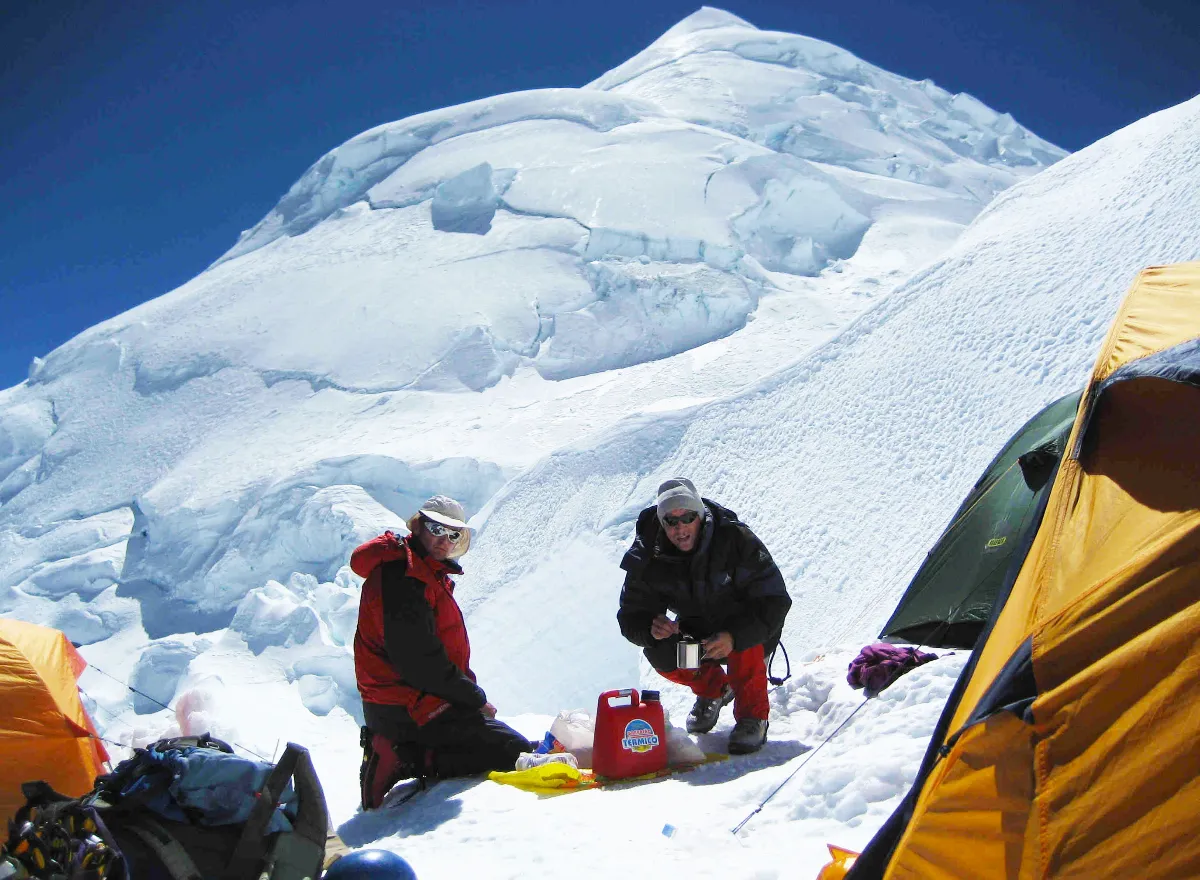
At base camp you have a cook, a dining tent with tables and chairs, a toilet tent, and full meals prepared with fresh produce — the same care you would find on any of our treks. Donkeys carry the heavy loads up to base camp on most mountains, so you walk in with a light daypack.

Where we use high camps, porters carry the tents, climbing rope, equipment and food, but you carry your own sleeping bag, mattress, personal clothes and climbing gear. You can hire a private porter if you would rather not. To keep the ice clean, we carry all human waste back down from the high camps using poo tubes — nothing is left on the glacier.

How we grade the climbs

The French alpine grading system

Our grades follow the French alpine system and are a general indication of difficulty only. Even peaks suited to beginners are graded medium to hard, because the altitude makes climbing on any Cordillera Blanca peak physically demanding — we do not consider any of them a "trekking peak".

Peu Difficile (Moderate)
PD

Peu Difficile (Moderate)

Moderate snow climbs. A rope is necessary, with basic anchor handling and sure crampon work on glaciated slopes.

Assez Difficile (Reasonably Hard)
AD

Assez Difficile (Reasonably Hard)

Routes with a fair amount of difficult climbing. Snow and ice experience and solid cardiovascular fitness are required.

Difficile (Hard)
D

Difficile (Hard)

A serious amount of snow and ice climbing, with pitches up to severe standards on steep, exposed ground.

Très Difficile (Very Hard)
TD

Très Difficile (Very Hard)

Very difficult, long and serious climbs on exposed mixed rock and ice. For experienced alpinists only.

Find your level

Peaks by climbing level

Pick a starting point. Beginner peaks double as excellent acclimatisation and preparation for the 6,000m and technical summits, and a strong novice with some instruction can step up to the intermediate peaks.

[ 01 ]

For novice climbers

  • Mountaineering Courses
  • Nevado Mateo (5,150m)
  • Nevado Urus (5,495m)
  • Nevado Ishinca (5,530m)
  • Nevado Pisco (5,753m)
  • Nevado Vallunaraju (5,686m)
[ 02 ]

For intermediate climbers

  • Nevado Yanapaccha (5,460m)
  • Nevado Copa (6,188m)
  • Nevado Chopicalqui (6,354m)
  • Nevado Tocllaraju (6,034m)
[ 03 ]

Technical peaks

  • Nevado Alpamayo (5,947m)
  • Nevado Quitaraju (6,036m)
  • Nevado Artesonraju (6,025m)
  • Nevado Pirámide (5,885m)
  • Nevado Huandoy (6,395m)
  • Nevado Huascarán (6,768m)
[ 04 ]

Multi-peak expeditions

  • Combine two or more peaks
  • Peaks not listed here
  • Planned around you
Expedition Logistics

Mountaineering Gear Specs

Load Protocol

Porters & Donkeys

We Provide (PAA Logistics)

  • Group climbing rope provided by your mountain guides

  • Group safety hardware: snow stakes and ice screws

  • Four-season high-camp tents with proper insulation

  • Stoves, fresh base-camp meals and high-camp food

  • Radio or walkie-talkie contact with our Huaraz office

You Need to Bring (Personal)

  • Double plastic or well-insulated mountaineering boots

  • Personal ice axe, alpine harness and belay/descent device

  • Step-in crampons fitted precisely to your own boots

  • Climbing helmet, locking carabiners and prusik loops

  • Warm sub-zero down sleeping bag and insulated mat

Climbs & courses available

Climbing routes and training courses we currently run, led by our UIAGM guides. These are brief summaries only — write to us for full details, prices, and peaks not listed here.

From our climbers

What our climbers tell us

"It is now a month since I returned from fulfilling the lifelong dream of standing on the tiny summit of the "Most Beautiful Mountain in the World". Everything went exactly as planned, and the service, places and people far exceeded my highest expectations. Your team is competent, efficient, reliable, passionate, helpful, kind and a true joy to be with — the best ambassadors Peru could wish for."

Alessandro (Switzerland)

Yanapaccha & Alpamayo Expedition

Tell us which summit you have in mind
Let us plan your climb

Tell us which summit you have in mind

Write to our team in Huaraz with the peak you are dreaming of, your dates and your climbing experience. We will reply with honest advice and a programme built around your level — and the UIAGM guide who will be on the rope with you.